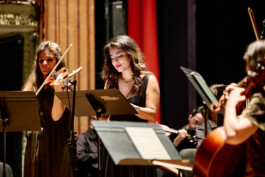
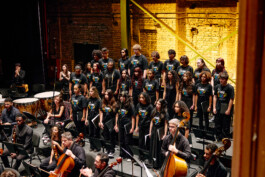
Artistic Research : Erasmushogeschool Brussel, Koninklijk Conservatorium Brussel. Orchestral piece : Commissioned by l'Itinéraire (DRAC Regional Department of Cultural Affairs - aide à la composition musicale France). Premiered by Laiana Oliveira (soprano), soloists of l'Itinéraire Ensemble (Mathilde Lauridon, Lucia Peralta, Myrtille Hetzel, Julie Brunet-Jailly, David Mengelle), USP Chamber Orchestra, Guri Santa Marcelina Young Choir, dir. Ricardo Bologna. 26 October 2025 Teatro Sao Pedro, Sao Paulo Brazil (Année France-Brésil official programmation) - finalist APCA Prize
Symphonia Botanica for soloists (soprano, flute, violin, viola, cello), choir (children or high voices), 5 percussionist and string orchestra.
Duration : Orchestral Suite Version : 20 minutes, Secular Passion Version : 50 minutes
Workshops based on Symphonia Botanica : Viveiros (improvisation for young string players), Creative Orchestra (composition for orchestra players), Songs of the Green Folks (folksong featuring plants and vegetal species for choir and vocal ensembles).
Sao Paulo Premiere, Teatro Sao Pedro, October 2025
I. Dream - Recitative
You should dream of the earth / For it has a heart and breathes / In dreams the forest speaks / The rivers tell truths / The spirits of the woods dance / And the earth pulses, alive. / You should dream / Of the roots that embrace the world / Of the winds that blow memories / You should dream of the waters. / You should dream / As the ancient trees dream / As the earth itself dreams / Before the sky falls. / You should dream to remember / That everything is alive / Orygham speak the leaves / In the motherlanguage of the world. / You should dream to feel / the pulse beneath your feet / And the earth's veins / in the fertile darkness of time. (Free adaptation, inspiration : The Falling Sky - Davi Kopenawa et Bruce Albert)
II. Amoa Hi for soprano and string orchestra
A single tree. A million mouths / Its whispering songs / Flow like a river / Without beginning or end / Numerous as the stars in the sky / Where earth embraces the horizon / Where rest the eternal roots of heaven / Infinite chorus of the forest / House woven of sounds.
III. Rose and Lily Song
I was in the Rose garden. / I sighed, further ahead I saw a Lily plant / It was crying, I was in love / It was scenting, I was in love / I sat down / When I stood up / It was crying, I was in love / It was scenting.
IV. Morning - Recitative
That morning you felt / The world's scent Manaçá, Peroba, / Cells unfolding in the sun / Microscopic music / That morning you saw / Deep green, light-green, shadow-green / In textures and reliefs / The spirals of time/ Taste of awakened chlorophyll / New moon's tongue / When you closed your eyes / You heard all this together.
V. Jurema Song
Gather flowers Oh little Jurema Oh Juremá / Leaves bark and seeds / Manacá, Paricá/ Clove cinnamon and ginger / Oh little Jurema / Juremiê / At the foot of Jurema there are flowers / Oh little Jurema / Eia Danda Juçá / Ouricuri foot of Manacá / Oh red sky / The arrow stained / The Mirror earth / Jurema Fell / Jurema Tenueflora / Mimosa Verrucosa / Mimosa Nigra / Persistent Mimosa / Bloomed.
VI. Ponta de Mata Song
Forest edge has Jackfruit / Has Cajui has Mango tree / Araticum and Guavira / Has Murici Gameleira. /Forest edge has Jackfruit / Has Cajui has Mango tree / Ingá Pacaba Guavira / Mangaba and Pitangueira.
Recitative (I and IV) : can be translated and adapted into the local language for each performance or translated on subtitles
Symphonia Botanica foregrounds an ecological perspective that resonates profoundly with the urgent challenges of our time. Drawing from diverse ways of knowing, including the wisdom of indigenous cultures, Symphonia Botanica encourages collaboration among individuals, environments, and institutions.
It creates spaces for deep listening and cohabitation. It proposes methods and practices designed to strengthen relationships within the orchestra. It aims to nurture interactions between musicians and their surroundings.

According to Yanomami mythology, all music on Earth originates from Amoa Hi, the Tree of Songs.
"These are immense trees, covered with a brilliantly shining down of blinding whiteness. Their trunks are covered with lips that move ceaselessly, one above the other. From these countless mouths continuously spring forth songs of incomparable beauty, as numerous as the stars in the heart of the sky. All the songs of the spirits come from these very ancient trees."
— Davi Kopenawa and Bruce Albert, The Falling Sky: Words of a Yanomami Shaman
Structured in short movements that follow a secular passion form—alternating recitative and songs. The string orchestra is surrounded by a percussion ensemble. This configuration brings an especially engaging role to the orchestra, inviting musicians into an active dialogue with one another and with their environment.
The score stimulates a high degree of sonic interaction, situating performers and audience alike within a polyphonic forest of sounds.
The Plant Songs in Symphonia Botanica
The plant songs simultaneously integrates species, myths, and spiritual entities. They weave a cosmology where the botanical and the sacred are inseparable.
Ponta de Mata (Forest Edge) creates a poetic inventory of the flowers, trees, and fruits of the Brazilian cerrado.
Jurema invokes simultaneously the myth, the healing plant, and the sacred tree from which ayahuasca originates. This song condenses multiple layers of meaning: Jurema as a spiritual entity in Afro-Brazilian traditions, as medicine in Indigenous rituals, and as a cosmological gateway opening onto other dimensions of consciousness.
O Jardim da Rosa e do Lírio (The Garden of the Rose and the Lily) brings into this Indigenous universe the world of colonial Brazil, marking the encounter with medieval Western representations of the masculine (rose) and feminine (lily).
These songs were collected from various regions of Brazil and rewritten within the context of Symphonia Botanica, as a sonic herbarium.
Symphonia botanica, by Michelle Agnes, is one of those emblematic works that speak to one of the greatest dramas of our time—an invitation for the 170 or 180 nations gathered in Belém do Pará at COP-30, the United Nations Conference on Climate Change, to reflect on this warning by Davi Kopenawa:
“The forest is alive. It can only die if the white people persist in destroying it. If they succeed, the rivers will disappear underground, the soil will crumble, the trees will shrivel up, and the stones will crack in the heat. The dried-up earth will become empty and silent. The xapiri spirits who come down from the mountains to play on their mirrors in the forest will escape far away. Their shaman fathers will no longer be able to call them and make them dance to protect us. They will be powerless to repel the epidemic fumes which devour us. They will no longer be able to hold back the evil beings who will turn the forest to chaos. We will die one after the other, the white people as well as us. All the shamans will finally perish. Then, if none of them survive to hold it up, the sky will fall.”
As the excellent soprano Laiana Oliveira delivered the moving texts of the shaman Davi Kopenawa, while the orchestra reproduced the rustling of leaves and the marvelous sounds of the forest, I felt immersed in the very entrails of the Amazon, transported to The Lost Steps, the masterpiece by Alejo Carpentier.
João Marcos Coelho, Complete article : Revista Concerto, 27/10/2025
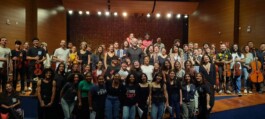
In São Paulo, the soloists of the French ensemble L’Itinéraire joined the University of São Paulo Chamber Orchestra, together with the Guri Santa Marcelina Choir. The project was presented as part of the official France–Brazil Season of the Institut Français. This initiative was accompanied by a series of meetings and workshops within the Guri Santa Marcelina social music program, a foundation that promotes music as a tool for social inclusion.

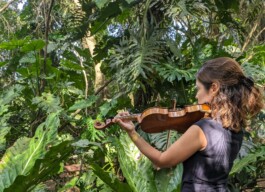
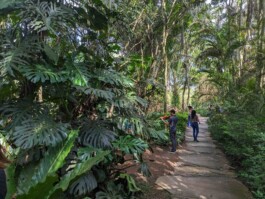
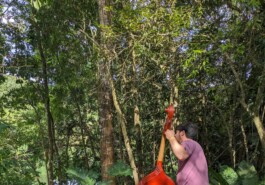
Research at Inhotim Institute Brumadinho MG
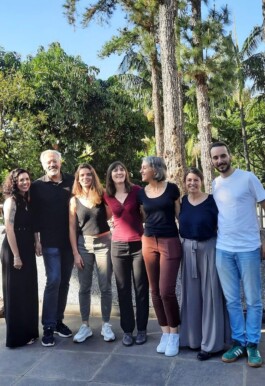
During this phase of the project, I participated in an artistic residency that enabled an exchange of knowledge with the Inhotim Institute’s team of biologists. Beyond being a monumental botanical garden and a leading contemporary art museum, the Institute also hosts an orchestra and a music academy. As part of the program What Is a Plant?, several cross-disciplinary projects were developed, encouraging dialogue between music, biology, and the visual arts.
The residency included workshops, open-air performances, and real-time composition sessions with the Inhotim Orchestra and the Inhotim Children’s Orchestra, conducted by Leandro Oliveira.